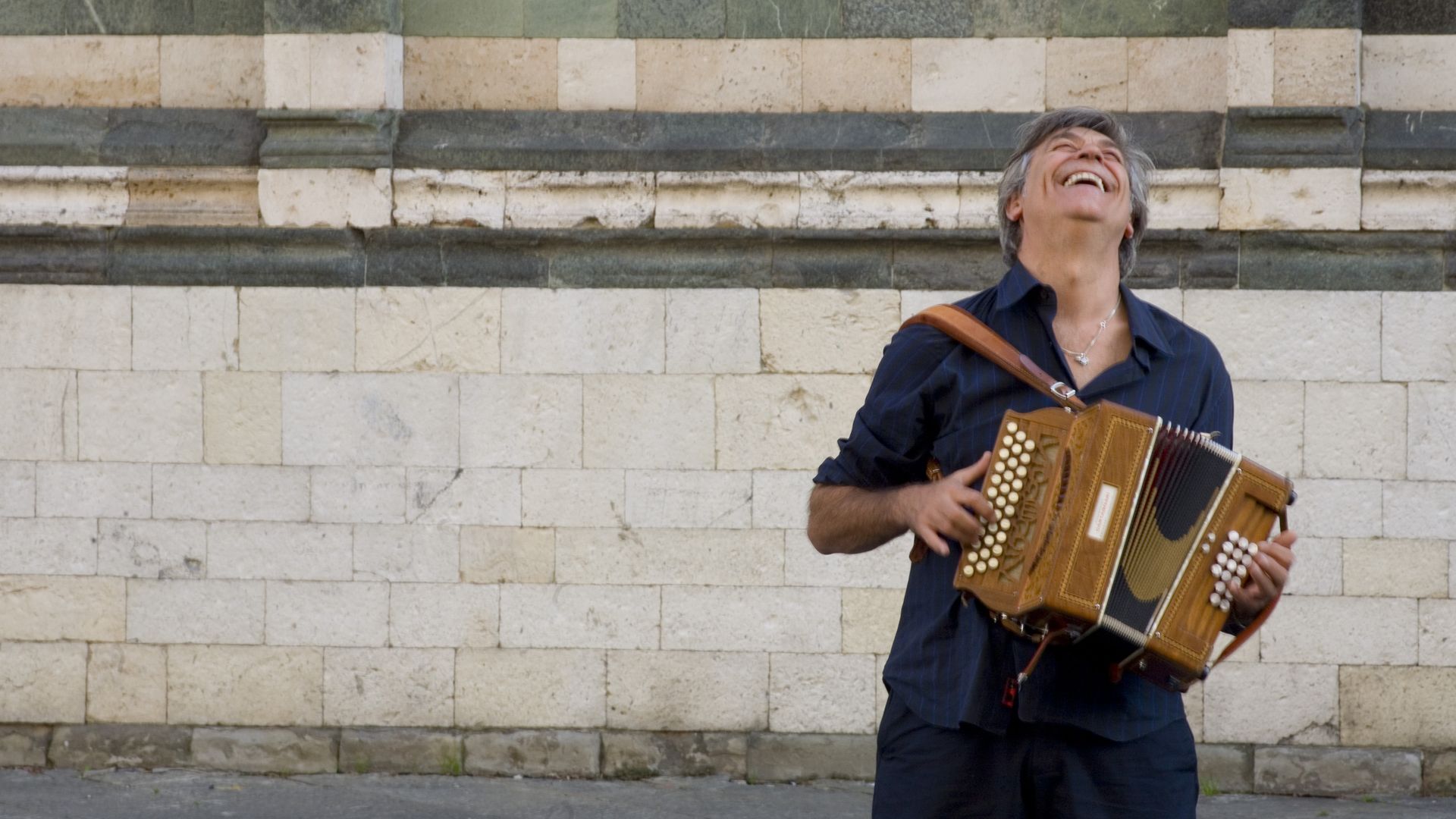
Riccardo Tesi, a traveler at the borders of time
– Composer, instrumentalist, arranger: these are the facets of the complex and multifaceted artistic personality of Riccardo Tesi, a true pioneer of ethnic music in Italy –
From his decidedly folk beginnings in 1978 alongside Caterina Bueno to his present-day collaborations, the musical story of Tesi from Pistoia is marked by a precious continuity made of passion and boundless curiosity, which from the Tuscan tradition has led him to engage with Italian, Basque, English, Occitan and Malagasy traditions, as well as with jazz, ballroom dance music (liscio), and singer-songwriter music.
What stands out about Tesi is his unmistakable style, through which he makes the diatonic button accordion speak a language that is both ancient and new, expanding the vocabulary and technique of an instrument that for a long time remained the exclusive heritage of tradition.
It was precisely to the diatonic button accordion, the popular instrument that predates the accordion, that he dedicated – the first in Italy – an entire album entitled “Il ballo della lepre” (1981).
From the recording of this album came the core of the group Ritmia, composed of Sardinian guitarist Alberto Balia and Italian-American multi-instrumentalist Daniele Craighead, soon joined by the singer, also Sardinian, Enrico Frongia. While maintaining a connection with tradition, the quartet evolved toward a music of creation, freer and more open to contemporary influences.
Their only album “Forse il mare” (1986) was also released in the United States and Spain and soon became a cult record.
In 1988 he recorded, as instrumentalist, the album Anita Anita, entirely dedicated to singer-songwriter music in the Occitan language, with the Tuscan-Provençal group formed by Jean Marie Carlotti, Daniele Craighead and Patrick Vaillant. With the latter he formed, in 1989, an extremely important partnership that still continues today.
Based on the unusual pairing of accordion and mandolin, the duo Tesi/Vaillant created at the time a fresh and innovative music that greatly expanded the vocabulary of these two folk instruments, breaking the narrow boundaries of folk music while searching for new inspiration in other styles and latitudes.
They recorded two albums for the newly founded Parisian label Silex by Philippe Krumm and Andre Ricros, which in those years became the reference label for “Musique traditionnelle d’aujourd’hui”, a movement of artists who, born in folk music, experimented with new and more adventurous musical paths.
The first album “Veranda” was released in 1991 and the second, “Colline”, recorded as a trio with the great jazz clarinetist Gianluigi Trovesi, in 1994. Both albums received enormous critical acclaim.
Also for Silex, in 1993 he recorded the album “Trans Europe Diatonique“ in a trio with two other international masters of the diatonic accordion, Basque musician Kepa Junkera and English musician John Kirckpatrick.
In 1998 the first album by Riccardo Tesi & Banditaliana was released. The group, founded in 1992, eventually became Tesi’s most important project, through which he fully realized his musical vision. The album marked the beginning of his collaboration with the label Il Manifesto and his return to Italy after the closure of Silex.
Banditaliana (formed by Maurizio Geri, Claudio Carboni and Gigi Biolcati) established itself over its thirty-year career as one of the most important Italian bands internationally, performing at major world music festivals across Europe and touring frequently in Canada, Japan and Australia.
They released six albums: “R.Tesi & Banditaliana“ (1998), “Thapsos” (2000), “Lune” (2004), “Madreperla” (2011), “Maggio” (2014), “Argento” (2018).
Banditaliana concluded its journey amicably with a farewell concert on December 31, 2024 at the Teatro Manzoni in Pistoia, from where they started, although the musicians still occasionally collaborate on other projects.
In 2007, to celebrate thirty years of his career, he recorded two albums under his own name, very different and in some ways opposite.
The first, Accordeon Diatonique, recorded entirely solo for the Cinq Planete label of Philippe Krumm, brought back to the center his role as an instrumentalist, often overshadowed by his work as an arranger.
In the second album, “Presente Remoto“, on the contrary, he invited many of his favorite musicians including pianist Stefano Bollani, the voices of Elena Ledda, Balentes, Ginevra di Marco and Gianmaria Testa, Neapolitan saxophonist Daniele Sepe, jazz clarinetist Gabriele Mirabassi, Sardinian musician Gavino Murgia, soprano saxophonist Cocco Cantini, Patrick Vaillant on mandolin and the musicians of Banditaliana for a great collective celebration.
The repertoire featured new compositions alongside two previously unreleased tributes to two great Italian singer-songwriters with whom Tesi had worked in the past, gaining significant experiences: Fabrizio De Andrè and Ivano Fossati.
In 2010 he joined Accordion Samurai, a project created by Frederique Dawans bringing together five of the most important European diatonic accordionists: Didier Laloy (Belgium), Bruno Le Tron (France), Markku Lepisto (Finland), Dave Munnelly (Ireland) and Riccardo Tesi (Italy). In 2011 the self-titled album was released, winning several awards and taking the group on tours across Europe.
In 2017 the group changed lineup with the departure of Didier Laloy and Bruno Le Tron and the addition of the young Simone Bottasso and Basque musician Kepa Junkera.
In 2018 the new album “TE” was released on Visage Music.
In the same year he also released the album “Cameristico”, which brings into dialogue the ethnic sound of the diatonic accordion with the classical sound of piano, cello and clarinet. Arranged together with pianist Daniele Biagini, it includes “La valse a Pierre”, one of his most famous pieces.
In 2023, after the dark pandemic period, he released a new album under his own name “La Giusta Distanza“, built around the musicians of the Elastic Trio (Vieri Sturlini on guitar and Francesco Savoretti on percussion), joined by many guests including singer-songwriter Giua, clarinetist Nico Gori, the voice of Ginevra Di Marco, nyckelharpa player Marco Ambrosini, and oud player Ziad Trabelsi, among others.
In 2024 the duo with singer-songwriter GIUA was formed; together they recorded live the album “Retablos”, dedicated to singer-songwriter music.
In 2025 he reunited, after more than 50 years, with Paolo Zampini, the friend from Pistoia with whom at the age of 13 he had taken his first steps in the world of music, united by a shared passion for Jethro Tull. Zampini had meanwhile become an established classical flutist and collaborator for 35 years with Ennio Morricone. From this reunion came the idea of recording the album CAMEROCK, with the collaboration of pianist Daniele Biagini as co-arranger and co-composer and cellist Enrico Guerzoni. The result is an original musical journey through imaginary film soundtracks, world music, a touch of classical, a hint of jazz and a long-standing love for progressive rock.
ORIGINAL PRODUCTIONS
At the same time, Riccardo Tesi developed other thematic projects commissioned by various institutions in which he approached specific repertoires, reinterpreting and reworking them in his own distinctive way.
In 1995 the producer Philippe Krumm asked Tesi to create an album dedicated to Italian ballroom dance music (“ballo liscio”), following the success of a similar French project entitled Paris Musette. Thus “Un Ballo Liscio” was born, dedicated to a rigorous and unconventional reinterpretation of this genre, which is extremely popular in Italy but often dismissed by official culture as kitsch and in poor taste. With a 12-piece ensemble including, among others, a classical string quartet, jazz musicians such as the clarinetist Gabriele Mirabassi, Patrick Vaillant on mandolin, folk musicians such as Maurizio Geri and Ettore Bonafè, and a true “liscio” performer such as Claudio Carboni, Riccardo Tesi created an album that soon became a milestone and a reference point for all later projects devoted to this musical genre.
In 2000, for the Province of Pistoia, together with Maurizio Geri, he created “Acqua Foco e Vento”, dedicated to traditional music from the Pistoia area, with an eight-piece band (Banditaliana, Nando Citarella, Mauro Palmas, etc.). The show achieved enormous success, leading to the release of a live album in 2001 and a studio album in 2003.
In 2006 the album “Crinali” was released, dedicated to the tradition of the Bolognese Apennines, this time together with Claudio Carboni and a band including Banditaliana, Ginevra Di Marco, Nico Gori, Stefano Melone, etc.
In 2010 the Musica dei Popoli Festival in Florence commissioned Riccardo Tesi and Maurizio Geri to create a tribute to Caterina Bueno, the great Tuscan singer and researcher who passed away in 2007 and with whom both musicians had begun their careers. The result was the double album “Sopra i Tetti di Firenze”, featuring the female voice of Lucilla Galeazzi and the participation of Gianna Nannini, Piero Pelù, Nada, Davide Riondino, etc.
In 2014, at the request of the musicologist Franco Fabbri, he worked on the new staging of “Bella Ciao” to celebrate the 50th anniversary of the historic show that initiated the folk revival in Italy. For the occasion he involved the voices of Elena Ledda, Lucilla Galeazzi, Ginevra Di Marco and Alessio Lega.
The enthusiasm with which the show and the 2015 album were received across Europe surprised the musicians themselves so much that in 2021 the group recorded a new album, “A Sud di Bella Ciao”, featuring Nando Citarella, dedicated to the music of Southern Italy which had been almost entirely absent from the original show.
In 2023 the Emilia-Romagna Region, working toward the recognition of Ballo Liscio as UNESCO intangible cultural heritage, commissioned Riccardo Tesi and Claudio Carboni to create a project similar to the 1995 album Un Ballo Liscio.
Thus in 2023 “Un Ballo Liscio Vol. 2” was released, involving pianist and accordionist Massimo Tagliata, who together with the two leaders also worked on the arrangements, jazz clarinetist Nico Gori, Maurizio Geri on guitar and vocals, Roberto Bartoli on double bass, Gianluca Nanni on drums, and the Alborada string quartet. Special guests include the voice of Tosca and the trumpet of Paolo Fresu.
CREATIONS
In 1996, commissioned by the French Ministry of Culture and the festival “Le Grand Soufflet”, he composed the original music for “Viaggio in Italia” for an orchestra of eighty musicians.
In 1997 he arranged and conducted, for the Folkermesse Festival in Vercelli directed by Maurizio Martinotti, “Transitalia” with E. Ledda, L. Galeazzi, D. Sepe, C. Muratori, Tenores di Bitti, etc., directed by Moni Ovadia.
In 2001, as composer-in-residence, he created the original work “Flatus Calami”, dedicated to Italian bagpipes (zampogne), for the Scapoli Festival (Isernia), documented in the CD of the same name.
In 2002 he composed the music for the opening ceremony of the Giro d’Italia in Groningen (Netherlands), arranged by Mirko Guerrini and performed by a 100-piece band.
COLLABORATIONS
Throughout his career Riccardo Tesi has collaborated with many prestigious artists including the Malagasy musician Justin Valì, the Canadian superband La Bottine Souriante, the Sardinian singer Elena Ledda, the Umbrian singer Lucilla Galeazzi, the Portuguese singer Amelia Muge, the Sicilian singer Rita Botto, with Stefano Saletti and Banda Ikona, the harpist Vincenzo Zitello, the clarinetist Gabriele Mirabassi, the tambourine players Carlo Rizzo, Alfio Antico, Andrea Piccioni, the pianist Rocco De Rosa, the Portuguese flutist Rao Kyao, the virtuoso Portuguese guitarist Custodio Castelo, the Neapolitan jazz singer Maria Pia De Vito, the guitarists Beppe Gambetta, Reno Brandoni and Peppino D’Agostino, the ethno-jazz musician Daniele Sepe, the humorous ensemble Banda Osiris, artists from the rock scene such as Francesco Magnelli, Ginevra Di Marco, Piero Pelù and Skiantos, the DJ Ominostanco, and leading figures of Italian singer-songwriting including Ivano Fossati, Fabrizio De André, Ornella Vanoni, Gianmaria Testa, Giorgio Gaber, Carmen Consoli, Carlo Muratori, Tosca, Cisco, Cristina Donà, Nada, Giua, Peppe Voltarelli, Mauro Ermanno Giovanardi, and many others.
THEATRE
In 2005 he composed the original music (performed by R. Tesi, M. Geri, D. Puliti) for the theatrical production Leldorado, a project by the Compagnia del Teatro dell’Argine, written by Mauro Boarelli and Nicola Bonazzi, starring Micaela Casalboni and directed by Andrea Paolucci.
In 2008 he composed the music for the play “La fine di Shavuoth”, a production of the Teatro Stabile of Bolzano directed by Cristina Pezzoli.
In 2011 he composed the music for the children’s performance “for voice, movement, images and objects” “La Barca e la Luna” by Roberto Frabetti, staged at Teatro Testoni in Bologna and directed by Valeria Frabetti.
In 2015, together with Daniele Biagini, he composed the soundtrack for “Calendar Girls” starring Angela Finocchiaro, Laura Curino, Carlina Torta, Ariella Reggio, Matilde Facheris, Corinna Lo Castro, etc. The show was a major box-office success and toured for three years, directed by Cristina Pezzoli.
READINGS
Based on an idea by the writer Stefano Tassinari, he took part in the festival “La parola immaginata” (San Lazzaro di Savena, Bologna), providing music with Banditaliana for readings of texts by the writers Bruno Arpaia and Daniel Chavarria, performed by Matteo Belli.
Together with Gianmaria Testa and Piero Ponzo, he composed the musical accompaniment for the reading of “The Tale of the Unknown Island” by José Saramago, performed by Antonio Cederna and directed by Giorgio Gallione (2001, Teatro Modena in Genoa).
For the 2005 literary series in Pistoia he created the show entitled “Maledetta Benedizione”: an evening dedicated to Tiziano Terzani with theatrical readings by Giovanni Fochi and music by Banditaliana.
FILMOGRAPHY
In the film L’estate di Davide by Carlo Mazzacurati he performed the music composed by Ivano Fossati. For the soundtrack of the film La lingua del santo (by C. Mazzacurati, starring F. Bentivoglio and A. Albanese), the director selected five tracks from the album “Un ballo liscio”. For the film L’amore ritrovato (by C. Mazzacurati, starring S. Accorsi and M. Sansa) he composed a piece for the soundtrack and also made a brief appearance in the film as a dance musician. He appears in the same role in the film Sogno di una notte di mezza estate by Michael Hoffmann (with M. Pfeiffer, K. Klein and R. Everett). In 2005 he composed the soundtrack for the film Liscio by Claudio Antonini (with L. Morante), appearing together with members of Banditaliana.
AWARDS
*1995 Paris, Grand Prix International du Disque de l’Académie Charles Cros for the album Colline by the trio Tesi/Trovesi/Vaillant (Silex)
*2002 International Accordion Competition and Award “Città di Castelfidardo” (27th edition) awarded Riccardo Tesi the “Voce d’Oro” prize for his work promoting and enhancing the image of the diatonic accordion on the international music scene. In previous years the award had been given to artists such as Richard Galliano, Astor Piazzolla, Gianni Coscia, Antonello Salis, etc.
*2004 “Gus Viseur” Award (Cité de la Musique, Paris) to Riccardo Tesi as best world diatonic accordion player
*2004 Mantova Music Festival, first prize for Riccardo Tesi & Banditaliana for best repertoire and interpretation in the “Festival Proposals” category
*2004 Pistoia, “Tradizioni e Oltre” Award to Riccardo Tesi presented by Maurizio Agamennone
*2005 City of Loano Award for Italian Traditional Music for the album “Lune” by Riccardo Tesi & Banditaliana as best Italian world music album
*2005 Florence, “Premio Aexequo per lo spettacolo” awarded by the Regione Toscana to Riccardo Tesi
*2005 Florence, “Odoardo Spadaro” Award to Riccardo Tesi
*2005 Udine, Folkest Festival, Lifetime Achievement Award “Una vita per la musica” to Riccardo Tesi, the first Italian artist to receive this award previously given to Noa, Ian Anderson, Joan Baez, Carlos Núñez, Paddy Moloney, etc.
*2005 Forte dei Marmi, Premio Musica Europa to Riccardo Tesi & Banditaliana
*2007 Insound Award for Best Ethnic Instrumentalist
*2010 “PIMPI – Premio Italiano Musica Popolare Indipendente” (MEI – Terra di Musiche) for “Best Ethno/Folk Revival Production” for “Sopra i tetti di Firenze” by R. Tesi and M. Geri
*2011 City of Loano Award for Italian Traditional Music for the album “Sopra i tetti di Firenze” by R. Tesi and M. Geri as best album of 2010
*2011 Paris, Grand Prix International du Disque de l’Académie Charles Cros awarded to the album Accordion by the group Samurai as best world music album of the year
*2012 Belgium, Octave de la Musique Award to the group Samurai
*2013 Orpheus Award for Cameristico as best Italian world music album
*2014 City of Loano Award for Traditional Music with Maggio (Banditaliana) as best album of the year
*2014 MEI BlogFoolk Choice Award with Maggio (Banditaliana) as best album of the year
*2015 Orpheus Award with Maggio (Banditaliana) as best Italian world music album
*2016 “Chiodo d’Oro” award from the Mercantia Festival for artistic merit (Certaldo)
*2018 Orpheus Award with Una vita a bottoni (Ed. Squilibri) as best Italian world music album
*2024 Orpheus Award with La giusta distanza as best Italian world music album of 2023
ARTISTIC DIRECTION
Since 2001 he has been appointed by the Cultural Office of the Province of Pistoia as artistic director of the “Sentieri Acustici” festival, which takes place in the most evocative locations of the Pistoia mountains.
From 2015 to 2021 he served as artistic director, together with Claudio Carboni, of the “Quarrata Folk Festival”.
PUBLICATIONS AND TEACHING
Since 1980 he has been dedicated to teaching and to the development of a pedagogy suited to folk instruments, particularly the diatonic accordion. Together with Roberto Tombesi he authored the first Italian manual devoted to this instrument, the method entitled “L’organetto diatonico”, published by Berbèn.
From 2019 to 2021 he taught diatonic accordion at the Tchaikovsky Conservatory of Catanzaro. He currently regularly holds workshops on diatonic accordion and ensemble music both in Italy and abroad. In 2016 the biography written by journalist Neri Pollastri, “Riccardo Tesi: una vita a bottoni”, was published by SQUILIBRI with an anthology CD included.